
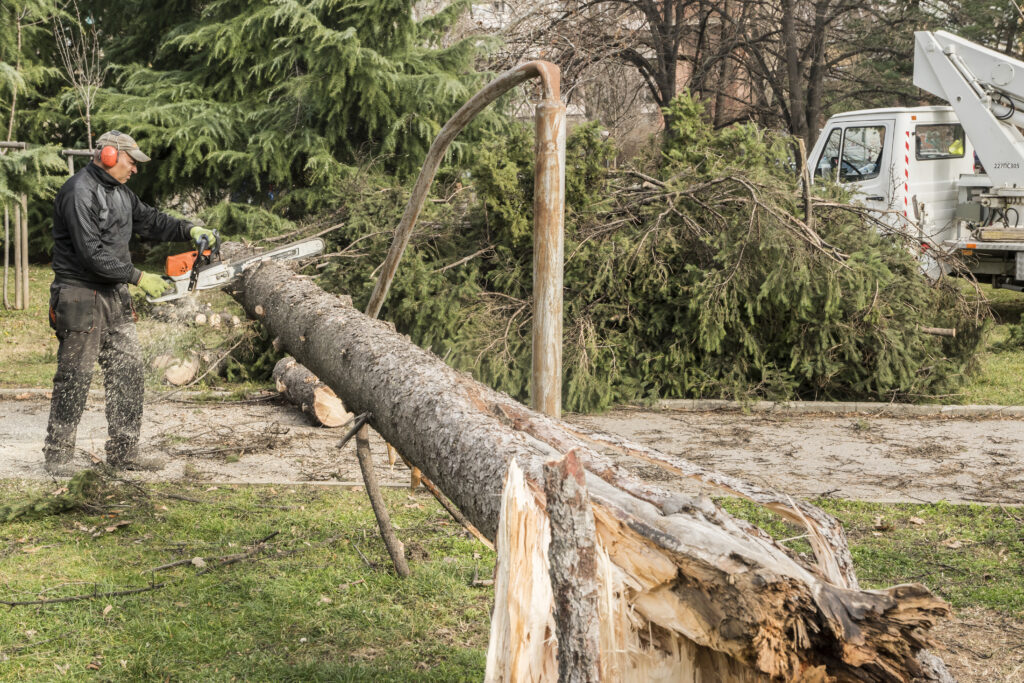
Root pruning can be safe for trees when it is done carefully, for the right reason, at the right distance from the trunk, and under the guidance of a qualified arborist. It can also be highly damaging when major roots are cut without assessment. Tree roots provide water, nutrients, oxygen exchange and structural support. Removing the wrong roots can weaken the tree, cause canopy decline, increase storm failure risk, or make the tree unsafe. In Melbourne, root pruning is commonly considered when roots are affecting paving, driveways, drains, retaining walls, building works or construction plans. The safest approach is to have an experienced arborist assess the tree, root zone, soil conditions and proposed works before any roots are cut.
Quick Summary
Root pruning may be safe when:
- The tree is healthy enough to tolerate root loss
- Only selected roots are pruned
- Cuts are made far enough from the trunk
- Major structural roots are protected
- The work is supervised by a qualified arborist
- Root pruning is part of a clear management plan
- Follow-up care is provided after pruning
Root pruning becomes risky when large roots are cut too close to the trunk, roots are removed without understanding tree stability, or excavation damages the root system without proper planning.
Table of Contents
- What Is Root Pruning?
- Why Tree Roots Matter
- When Is Root Pruning Considered?
- Is Root Pruning Safe for Every Tree?
- What Makes Root Pruning Risky?
- How Arborists Assess Root Pruning Safety
- Structural Roots vs Feeder Roots
- How Close to the Trunk Can Roots Be Cut?
- Root Pruning for Driveways, Paths and Paving
- Root Pruning Near House Foundations
- Root Pruning During Construction
- Root Barriers and Root Management
- Aftercare Following Root Pruning
- When Tree Removal May Be Safer
- Common Mistakes Homeowners Make
- Real World Examples
- FAQs
- Summary
- Call Banyan Tree Care
1. What Is Root Pruning?
Root pruning is the selective cutting or removal of tree roots.
It may be carried out to manage conflicts between roots and:
- Footpaths
- Driveways
- Paving
- Retaining walls
- Drains
- Building foundations
- Garden beds
- Construction works
- Underground services
- New landscaping
Root pruning is not the same as random digging or cutting roots with a shovel.
Professional root pruning involves assessment, planning, clean cuts, and consideration of how the tree will respond.
A qualified Arborist Melbourne will assess whether root pruning is suitable before recommending it.
2. Why Tree Roots Matter
Roots are essential to tree health and safety.
They help the tree:
- Absorb water
- Absorb nutrients
- Store energy
- Anchor itself in the soil
- Interact with beneficial soil organisms
- Respond to drought and stress
- Maintain canopy health
Many important roots grow close to the soil surface.
This surprises many homeowners. Tree roots are often imagined as deep underground structures, but many absorbing roots grow in the upper soil layer where oxygen and moisture are available.
Damage to these roots can affect the whole tree.
Damage to larger structural roots can also affect stability.
3. When Is Root Pruning Considered?
Root pruning may be considered when roots are creating a specific conflict.
Common reasons include:
- Lifted paving
- Cracked paths
- Raised driveways
- Roots entering damaged pipes
- Roots interfering with garden walls
- Building works close to a tree
- Driveway replacement
- Footing installation
- Retaining wall construction
- Root barrier installation
- Managing roots before landscaping
Root pruning should always have a clear purpose.
Cutting roots simply because they are visible is rarely good practice.
Surface roots may look inconvenient, but they may also be important for the tree’s stability and health.
4. Is Root Pruning Safe for Every Tree?
Root pruning is not safe for every tree.
The level of risk depends on:
- Tree species
- Tree age
- Tree health
- Tree size
- Root size
- Root location
- Soil type
- Site exposure
- Lean
- Existing defects
- Past root damage
- Distance from buildings or public areas
- Amount of root loss proposed
A young healthy tree may tolerate minor root pruning better than a mature declining tree.
A mature gum tree growing near a house, driveway or school may require a much more cautious approach.
A qualified arborist services Melbourne provider will assess the entire tree before deciding whether roots can be pruned safely.
5. What Makes Root Pruning Risky?
Root pruning becomes risky when it affects important support roots or removes too much of the absorbing root system.
Risks include:
- Canopy dieback
- Reduced water uptake
- Reduced nutrient uptake
- Drought stress
- Increased pest and disease vulnerability
- Fungal infection through root wounds
- Loss of anchorage
- Increased risk of windthrow
- Gradual decline over several years
The most serious risk is instability.
If major roots are cut close to the trunk, the tree may lose some of its anchorage. This can increase the risk of failure during storms, heavy rain or saturated soil conditions.
Root pruning should never be treated as a simple landscaping job.
6. How Arborists Assess Root Pruning Safety
Before recommending root pruning, an arborist may assess:
- Tree species
- Tree health and vigour
- Canopy condition
- Trunk diameter
- Root flare
- Visible roots
- Soil condition
- Drainage
- Structural defects
- Lean direction
- Target areas
- Proposed cutting location
- Root size and number
- Likely impact on stability
- Future use of the site
Where needed, the arborist may recommend root investigation before cutting.
This can involve careful excavation to expose and identify roots before decisions are made.
On construction sites, arborists may supervise excavation to ensure important roots are retained where possible.
7. Structural Roots vs Feeder Roots
All roots matter, but they do not all perform the same role.
Structural roots
Structural roots are larger roots that help anchor the tree.
They are often found closer to the trunk and provide stability.
Cutting major structural roots can be dangerous.
Feeder roots
Feeder roots are smaller roots that absorb water and nutrients.
They are often finer and grow through the upper soil layers.
Losing some feeder roots may stress the tree, but losing major structural roots can create safety concerns.
A professional arborist distinguishes between root types before deciding whether pruning is acceptable.
8. How Close to the Trunk Can Roots Be Cut?
The closer root pruning occurs to the trunk, the greater the risk.
Roots near the trunk are more likely to be important for stability.
Cutting roots close to the trunk can:
- Reduce anchorage
- Create decay entry points
- Affect water and nutrient uptake
- Increase the risk of tree failure
- Reduce the tree’s useful life
There is no single safe distance that applies to every tree.
A small ornamental tree and a mature eucalyptus cannot be assessed in the same way.
Arborists consider trunk diameter, species, health, soil, root size, wind exposure and surrounding targets before deciding whether root pruning is safe.
9. Root Pruning for Driveways, Paths and Paving
Root pruning is often requested when roots lift paths or driveways.
In some cases, selected roots may be pruned and the surface repaired.
In other cases, cutting the roots may be unsafe or ineffective.
Alternative options may include:
- Raising the path slightly
- Using flexible paving
- Installing permeable surfaces
- Bridging over roots
- Redesigning the path
- Using mulch instead of hard paving
- Redirecting pedestrian access
- Removing and replacing the tree where retention is unsuitable
For mature trees, the best solution may involve changing the hard surface rather than cutting major roots.
An arborist can advise whether root pruning, surface redesign or tree removal Melbourne is the safest option.
10. Root Pruning Near House Foundations
Root pruning near house foundations needs careful assessment.
Roots may be involved in foundation concerns, but they are not always the only cause.
Foundation movement may also relate to:
- Reactive clay soil
- Poor drainage
- Leaking pipes
- Shallow footings
- Building age
- Existing structural cracks
- Seasonal soil moisture changes
Cutting roots may not solve the problem if soil movement or drainage is the main issue.
In some cases, root pruning may make the tree unstable without fixing the foundation concern.
Where house movement is involved, an arborist may recommend input from a structural engineer or plumber.
11. Root Pruning During Construction
Construction is one of the most common reasons root pruning is considered.
Roots may be affected by:
- Footing excavation
- Driveway installation
- Service trenches
- Retaining walls
- Pool excavation
- Decking
- Drainage works
- Landscaping
On development sites, root pruning should be planned in line with tree protection requirements.
A consulting arborist may prepare:
- Arborist Report
- Tree Protection Plan
- Root investigation report
- Arboricultural Impact Assessment
- Construction supervision notes
AS 4970 Protection of Trees on Development Sites is commonly used where retained trees may be affected by building works.
A major part of construction root management is avoiding unnecessary root pruning through better design.
12. Root Barriers and Root Management
Root barriers are sometimes used to help direct roots away from structures.
They may be considered near:
- Paths
- Paving
- Driveways
- Walls
- Underground services
- New planting areas
Root barriers must be installed carefully.
Poor installation can:
- Cut important roots
- Redirect roots into worse locations
- Affect tree stability
- Fail to solve the original issue
- Create drainage problems
Root barriers are best used as part of a broader root management plan.
They are not a universal fix.
An arborist can advise whether a root barrier is suitable for the tree and site.
13. Aftercare Following Root Pruning
After root pruning, the tree may need support to recover.
Aftercare may include:
- Deep watering during dry periods
- Mulching around the root zone
- Avoiding further soil disturbance
- Avoiding heavy compaction
- Monitoring canopy condition
- Avoiding excessive canopy pruning
- Improving soil health
- Checking for fungal activity
- Follow-up arborist inspections
The tree’s response may take time.
Canopy thinning, leaf drop or dieback may not appear immediately. Some trees show stress months later, especially during hot or dry weather.
Aftercare helps reduce stress and improve recovery.
14. When Tree Removal May Be Safer
Sometimes root pruning is not the safest option.
Tree removal may be recommended where:
- Major roots must be removed close to the trunk
- The tree is already unstable
- The tree has severe decay
- The root system is already damaged
- The tree is in poor health
- Root pruning would leave the tree unsafe
- The tree is causing severe repeated damage
- Construction cannot avoid critical roots
- The tree has low retention value
Professional Tree Removal Melbourne may be safer than leaving a destabilised tree standing.
A responsible arborist will explain why root pruning is unsuitable and document the reasoning where needed.
15. Common Mistakes Homeowners Make
Root pruning is often misunderstood.
Common mistakes include:
- Cutting roots without assessment
- Removing large surface roots near the trunk
- Assuming all visible roots can be removed
- Using an excavator without arborist supervision
- Cutting roots to install paving
- Ignoring tree stability
- Treating root pruning as a DIY task
- Installing root barriers incorrectly
- Cutting roots during drought stress
- Forgetting to provide aftercare
- Removing roots from neighbouring trees
- Ignoring council requirements for protected trees
The safest rule is simple: do not cut significant roots without arborist advice.
16. Real World Examples
Example 1: Lifted Driveway Near a Mature Tree
A homeowner contacted Banyan Tree Care because roots had lifted part of a concrete driveway.
The owner wanted the roots cut and the driveway replaced.
After inspection, our arborist found that several large roots were close to the trunk and likely important for stability. Cutting them would have increased the risk of future tree failure.
Instead, the recommendation was to modify the driveway design and use a less invasive surface treatment near the tree.
The tree was retained, and the driveway issue was managed without unnecessary risk.
Example 2: Root Pruning for a New Footpath
A commercial property needed a new pedestrian path near a healthy ornamental tree.
The arborist supervised careful excavation and identified several small roots and one larger root. The path alignment was adjusted slightly to avoid the larger root. Minor roots were pruned cleanly, and the tree was mulched and monitored afterward.
Because the work was planned, the tree remained healthy and the project was completed safely.
Example 3: Tree Removal After Unsafe Root Conflict
A large tree was growing very close to a proposed retaining wall. The required excavation would have removed major roots on one side of the tree.
The arborist assessed the tree and determined that root pruning would compromise stability. Retaining the tree after cutting those roots would create an unacceptable risk.
In that situation, tree removal was recommended before construction continued.
FAQs
1. Is root pruning safe for trees?
Root pruning can be safe when it is limited, planned and carried out under arborist guidance. It becomes unsafe when large roots are cut too close to the trunk or when too many roots are removed. The tree’s species, size, health, soil conditions and location all affect the level of risk. A qualified arborist should assess the tree before root pruning is attempted.
2. Can cutting tree roots kill a tree?
Yes, cutting roots can kill a tree if too much of the root system is removed or if major roots are damaged. Sometimes decline happens slowly over months or years. Symptoms may include canopy thinning, dead branches, leaf drop and reduced growth. Root cutting can also make the tree unstable, especially if structural roots are affected.
3. How many roots can be safely removed?
There is no universal number or percentage that applies to every tree. Safe root pruning depends on root size, root location, tree species, health, age, soil conditions and distance from the trunk. Arborists usually aim to remove as little as possible. Major roots close to the trunk should be treated with extreme caution.
4. Can I cut roots that are lifting my driveway?
You should not cut driveway roots without arborist advice. Some roots may be safe to prune, while others may be critical for tree stability. Alternatives such as flexible paving, raised surfaces, path realignment or bridging over roots may be safer. An arborist can assess whether root pruning or surface modification is the better solution.
5. Is root pruning better than tree removal?
Root pruning is better when the tree can remain healthy and stable after the work. Tree removal may be safer when root pruning would remove major support roots, worsen decline or create a hazard. A qualified arborist will compare the risks and recommend the option that best protects people, property and tree health.
6. Can root pruning stop roots from damaging foundations?
Sometimes root pruning may help manage root conflict, but foundation damage is often more complex. Soil type, drainage, footing design and pipe leaks may also be involved. Cutting roots may not solve the issue and could make the tree unstable. Arborist advice, and sometimes engineering or plumbing advice, is recommended before root pruning near foundations.
7. Can root pruning stop roots entering pipes?
Root pruning may remove roots near damaged pipes, but it does not fix the pipe. Roots usually enter pipes through cracks or poor joints. A plumber should inspect and repair the damaged pipe. The arborist can assess whether nearby trees need root management, pruning, monitoring or removal.
8. What time of year is best for root pruning?
The best timing depends on species, tree health, weather and the reason for pruning. Root pruning during drought, extreme heat or tree stress can increase risk. Where possible, work should be planned when the tree is better able to recover. Urgent construction or safety work may require immediate action with extra care and aftercare.
9. Does root pruning need council approval?
Council approval may be required if the tree is protected and the root pruning is significant. Requirements vary between Melbourne councils. Root pruning can count as tree damage if it affects health or stability. Before cutting roots from a significant or protected tree, check council requirements or ask a qualified arborist.
10. Can root pruning affect neighbouring trees?
Yes. Roots often extend across property boundaries. Cutting roots on your property may damage a neighbour’s tree if those roots belong to it. This can create safety, legal and neighbour dispute issues. Arborist assessment is recommended before cutting roots near boundaries.
11. What is the difference between root pruning and root damage?
Root pruning is planned, selective and carried out with clean cuts for a specific reason. Root damage is often accidental and may happen through excavation, trenching, machinery, compaction or tearing. Clean pruning cuts are generally better for tree response than torn or crushed roots caused by machinery.
12. Should the canopy be pruned after root pruning?
Sometimes canopy pruning may be considered after root pruning, but it is not automatic. Excessive canopy pruning can add more stress to the tree. The decision depends on the amount of root loss, tree species, health and site conditions. A qualified arborist should decide whether tree pruning Melbourne is needed after root work.
13. Can root barriers replace root pruning?
Root barriers sometimes require root pruning during installation. They can help redirect roots in certain situations, but they are not suitable for every tree or site. Poorly installed barriers can damage roots, affect drainage or fail to solve the problem. Root barriers should be designed as part of a professional root management plan.
14. How do arborists inspect roots before pruning?
Arborists may inspect visible surface roots, root flare, soil conditions, tree health and surrounding structures. In some cases, careful excavation, air spade work or non-destructive digging may be used to expose roots before decisions are made. This helps identify which roots can be pruned and which should be retained.
15. Who should carry out root pruning?
Root pruning should be planned or supervised by a qualified arborist, especially near mature trees, buildings, construction areas, drains, driveways or public spaces. Banyan Tree Care provides professional arborist services Melbourne, root assessments, root management advice, Arborist Reports and safe tree removal where root pruning is not suitable.
Summary
Root pruning can be safe for trees when it is done carefully and based on professional assessment. It can also be dangerous when large roots are cut without understanding their role in tree stability and health. The safest root pruning is selective, minimal, cleanly cut, and carried out with a clear purpose.
The decision depends on the tree species, size, health, root location, soil conditions, nearby structures and the amount of root loss proposed. In many cases, alternatives such as raised paving, path realignment, root barriers, construction design changes or ongoing monitoring may be safer than cutting major roots.
Before pruning roots, speak with a qualified arborist. A careful assessment can protect your tree, your property and your safety.
Call Banyan Tree Care for Root Pruning Advice in Melbourne
If tree roots are affecting your driveway, paving, drains, retaining wall, foundations or construction plans, Banyan Tree Care can help.
We provide professional arborist services Melbourne, root assessments, root pruning advice, Arborist Reports, Tree Risk Assessments, tree pruning Melbourne, stump grinding Melbourne, root management and safe tree removal Melbourne where removal is genuinely required. Contact Banyan Tree Care on 0432 277 627 to arrange a professional arborist inspection and practical advice for your property.